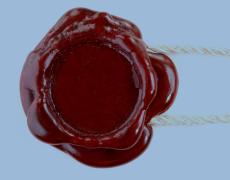
A seal is any device that hermetically closes a package to protect the content from tampering. Seals can be made of plastic or metal and can be as simple and cost-effective as a screwcap on a bottle. They are usually easy to install and remove, but the level of security they offer depends to a great extent on the experience and ability of the person inspecting them.
Used for
Anti-tampering / Anti-alteration
Suitable for
Small products
Medium-sized products
Large products
Goes on
Product
Packaging
Can be used for
Physical products
Visibility
Visible
Reading device needed
No
Connection to server
No
Description
The general properties of a seal are:
- identity – every seal has a unique identifier;
- non-duplicability – seals are very difficult to reproduce;
- reliability – they provide a high level of security.
Although there are various different types of mechanical seals, they all share the following characteristics:
- their integrity is established through visual inspection;
- they reassure the user as to the security of a product by providing visual evidence of any tampering;
- they do not record information about the time or place of any tampering;
- they are unable to check their own integrity, unlike electronic seals.
Uses
Seals are highly versatile and can be used on a vast range of different packages in a variety of sectors. They are even used in transport to secure freight containers.
Implementation
As seals are generally applied to the packaging rather than the product itself, the changes that need to be introduced in order to implement this technology will affect the wrapping and packaging stage – not the production process.
Cost
While it is difficult to give a general idea of the costs associated with mechanical seals because of their diversity and versatility, it can be said that they are much lower than the costs associated with electronic seals.