Shared ledger technology is a form of digital data storage that is intended to create faster and more secure ways to transmit, receive, track and perform transactions. Blockchain is the most famous form of shared ledger technology. It uses a decentralised architecture, with no need for trusted intermediaries. All data related to a transaction, including its origin, must be validated by all participants in the blockchain. Once validated, the transaction data is encrypted and stored in a new block. A copy of the encrypted data is also included in the subsequent block, forming the link in the chain. Once data has been added to a block, it can never be erased, enabling participants to verify the entire history of a transaction. The idea behind blockchain came from the need to find a way to secure digital currencies from the risk of replication. That led to the creation of Bitcoin, the world’s first ‘cryptocurrency’, which utilises strong cryptography to allow online payments to be sent directly from one party to another without going through a financial institution.

Description
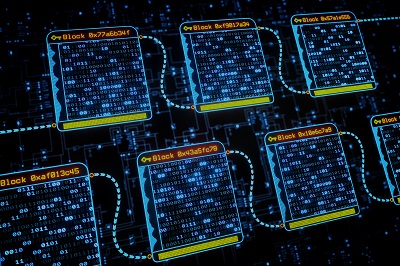
Blockchain is a type of ‘shared ledger’ technology, where all computers participating in the network (nodes) have an identical copy of the ledger (which is essentially a database of transactions). Any time a new transaction is added to the ledger, a record of that transaction appears in every participant’s copy as well. Blockchain’s decentralised architecture means that, aside from keeping real-time duplicate copies of the ledger, each node in the system also verifies every transaction that takes place before it can be added as a new entry. Therefore, blockchain is not dependent on a single internal or external entity for validating, monitoring or checking transactions, or changing data; that is all done by the network. These features ensure the consistency of all the existing data in a blockchain. Furthermore, as all the data stored in a blockchain is available to everyone from the very beginning, previous transactions can easily be checked and traced.
The term ‘blockchain’ comes from a combination of ‘block’ and ‘chain’, where:
- a block is the record of a transaction (e.g. the transfer of physical assets from one participant of the network to another); and
- the chain is the infrastructure linking the blocks altogether.
The chain component works via a ‘hash’ function – an algorithm that encrypts the transaction data by transforming it into a fixed-length string of letters and numbers. The hash function is irreversible, meaning it is basically undecipherable. Once a new transaction has been verified, the data gets hashed. Each new block contains its own unique hash and the unique hash of the previous block, linking the two together and creating the links in the chain. This makes it easy to uncover any tampering in a blockchain as the tamperer would have to change the hash in the next block to cover their tracks, and then the hash in the next block after that, and in the next block after that, and so on. And they would not have to do that in only one ledger, but in all the ledgers in all the nodes connected to the blockchain.
Blockchain systems are classified according to accessibility (public or private) and editability (permissioned or permission-less).
- In public permission-less blockchains, anybody can participate in the network, and read and write the data without needing permission. These blockchains are inherently transparent, as all actions on the network must be validated by, and be visible to, all participants. Any action not visible to all participants cannot be properly validated. In public permissioned blockchains, anybody can read the data, but only selected participants can write it.
- In private blockchains, permission is needed to join and participate in the network. Participants may be assigned a mix of read and write permissions. This ability to assign a variety of permissions to network participants is particularly useful for contexts such as health care, where certain actions and information need to be kept private, but where participants benefit from the security of a shared infrastructure.
Uses
Although blockchain is still a rather new technology, there are some solutions already being used for anti-counterfeiting. Among other things, such solutions allow companies to create their own product IDs and monitor their own supply chains. There is no single standard for using blockchain to combat counterfeiting, but examples can be found in sectors such as luxury goods, diamonds, agri-food, electronics and pharmaceuticals.
Implementation
To give you an idea of how blockchain could be implemented in practice, here is an example of how it would be used to secure a pharmaceutical supply chain.
- The participants in the chain are the manufacturer, the packager, the wholesaler, the distributor, the doctor, etc. A participant may be a device, a person or an entity. Each participant is assigned a key denoting their specific activity in the network. The participant’s original identities are hidden and they are known only by these keys – ‘manufacturer’, ‘packager’, etc.
- Medicines are the ‘assets’ in the chain. Each medicine is given a unique key (or hash). The medicine’s ID is attached to it in the form of a QR Code.
- A specific blockchain network must be chosen to store the transaction records. Bitcoin Blockchain (the pioneer network), Ethereum, Hyperledger and BigchainDB are some examples of networks available on the market.
- All the required transactions are stored on the blockchain. Once the information for a certain transaction has been entered into the blockchain, it can never be changed.
- Participants use a mobile app to make transactions via the blockchain.
- When a new medicine is produced, the manufacturer creates a unique hash to be assigned to it (a unique ID). The medicine is registered on the blockchain. It will be considered as a digital asset on the blockchain network and its hash will be used to track it at any point or time throughout the network.
- The medicine ownership can easily be transferred to another participant via a mobile app. Possible scenarios are:
- the wholesaler purchases the medicine from the manufacturer – the manufacturer physically transfers the medicine to the wholesaler and a transfer transaction is simultaneously registered on the blockchain;
- the wholesaler sells the medicine to another wholesaler, a distributor or a pharmacy – the same transfer and registration process applies;
- a doctor purchases the medicine from the pharmacy – the doctor will use the app to get the medicine’s ID, and, by tracing its journey through the blockchain from manufacturer to pharmacy, will be able to see whether the medicine is genuine or counterfeit:
- if the medicine is genuine, its entire product history will be shown;
- if it is counterfeit, no record will be displayed.
Cost
Identifying the general costs involved in setting up a production-scale commercial blockchain solution is not easy, as each solution is highly specific to the particular context and scale of implementation. The main factors that influence costs are the type of blockchain network being used (public or private) and the transaction volume and size. It is also worth bearing in mind that blockchain solutions require a significant amount of energy to power their processing speeds and performance, and as such are a great deal more energy intensive than centralised peer-to-peer networks.
However, blockchains do save money in other areas. As blockchain-based solutions provide ways for contracts and payments to be executed smoothly and securely without involving third parties, they remove the third-party verification and transaction costs associated with current physical contracting and payment procedures.