Inks in this category contain metallic pigments that react strongly to magnets. These ‘magnetic flakes’ can be detected and read by special devices. Magnetic inks are most commonly used for serialisation and numbering on banknotes and cheques. However, they can also be used to encode documents with a magnetic bar code, via which the information can be read and the documents can be authenticated.
Used for
Authentication
Anti-tampering / Anti-alteration
Suitable for
Very small products
Small products
Medium-sized products
Large products
Goes on
Product
Packaging
Can be used for
Physical products
Visibility
Invisible
Reading device needed
Yes
Connection to server
No
Description
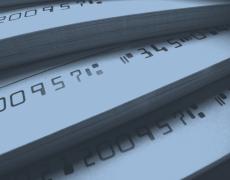
The most well-known magnetic ink technology is MICR (magnetic ink character recognition), which is used in many countries to number cheques (the set of characters running along the bottom). It is specified by the ISO 1004 standard.
MICR numbers are magnetised on the plane of the paper with their north pole on the right. Their stylised, rounded characters make them easy for people to recognise and machines to read, as their shape produces a unique waveform that can be easily identified by character recognition systems. The magnetic ink (normally containing iron oxide) ensures that the MICR numbers are reliably read by character recognition devices even when they have been written over or otherwise obscured by conventional ink marks, such as cancellation stamps.
Uses
Magnetic inks are mostly used on banknotes, documents, cheques, stamps and credit cards.
Implementation
If you want to print magnetic ink directly onto the surface of your product(s), then you will need to make sure you have the appropriate processes in place to do this during production. The printing process will need to be adapted to ensure that the ink is applied in the desired position.
Cost
The costs associated with magnetic inks vary significantly depending on the use. It is therefore difficult to give a general idea here of the investment required.