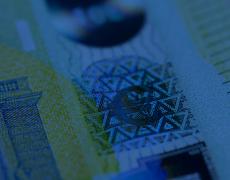
Traditional holograms are three-dimensional images that provide a visual way of authenticating a product or a document, as the presence of one is intended (and generally understood) to reliably indicate authenticity. Holograms can be incorporated into adhesive labels or they can be printed directly onto a product or its packaging.
Used for
Authentication
Suitable for
Very small products
Small products
Medium-sized products
Large products
Goes on
Product
Packaging
Can be used for
Physical products
Visibility
Visible
Reading device needed
No
Connection to server
No
Description
There are various types of traditional holograms and methods for making them:
- 2D - 3D holograms (multi-layer): the 3D effect that these provide is not an optical illusion but rather the depth of several layers of 2D holograms.
- 3D holograms: the image in these holograms has three dimensions of length, breadth and depth. The 3D effect is produced by a 3D physical model that comes out of the holographic plane; the holographic image is the full set of information on the wave front emitted by an illuminated object.
- Dot-Matrix: this is one of the most widely used hologram technologies for anti-counterfeiting. A design comprising many tiny dots, each of which is a separate diffraction grating, creates an impression of a 2D or a 3D image. The dots measuring several tens of microns in size are far too small to be seen by the naked eye.
- Hot Stamping Foil (HSF): this is a dry printing method of lithography in which pre-dried ink or foils are transferred to a surface at high temperatures. It is widely used to secure paper and plastic products but is applicable to other materials as well.
- Holograms obtained via a de-metallization process: aluminium is deposited onto the hologram and then selectively removed in a graphic pattern. It is possible to make printouts that have metallised and transparent parts on the same film, thereby providing additional protection or design improvements.
Uses
Traditional holograms can be applied to all types of materials, including paper, plastic, fabrics and ‘tamper-evident’ materials (e.g. destructible labels).
Implementation
If you want to incorporate traditional holograms into labels, you do not need to make any changes to the production process. However, if you want to print holograms directly onto your products, you will need to carry out a feasibility check and, if feasible, make the appropriate changes to the production chain.
Cost
The costs associated with traditional holograms vary according to the type of hologram, the size, the physical processes involved and the technique used to attach the hologram to the product.