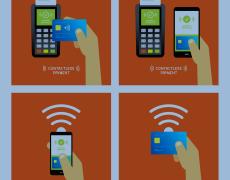
NFC technology is currently available in most smartphones and smartwatches, where it allows users to link a credit card to their device and make payments when the device is close enough to an NFC-enabled payment machine. It is also used for paying on public transport and authenticating products. NFC transactions are normally concluded within seconds.
Used for
Authentication
Tracking/Tracing
Suitable for
Very small products
Small products
Medium-sized products
Large products
Goes on
Product
Packaging
Can be used for
Physical products
Visibility
Invisible
Reading device needed
Yes
Connection to server
Yes
Description
NFC technology is a set of communication protocols for secure wireless communication between electronic devices less than 10 cm from each other. It derives from contactless card and RFID technologies. However, unlike these technologies, it moves away from the rigid distinction between reader and tag and passive and active devices. An NFC system can both send and receive queries, and – operating as a tag – it can work in both active and passive mode. NFC devices can be set either to communicate only when specific conditions are met, or to communicate in the same way as contactless cards do – fairly indiscriminately; in both cases, they operate at a frequency of 13.56 MHz.
In contrast to RFID system readers, which can read a large number of tags simultaneously (a useful function in logistics, for example), NFC readers can communicate with only one tag at a time. This makes NFC technology particularly suited to securing transactions such as credit card payments.
Uses
NFC tags can be embedded into objects as small as payment cards and possibly even paper labels. Consequently, they can be used with a diverse range of products and materials.
As many smartphones already come with NFC tag readers built in, consumers can use this technology to check the authenticity of products themselves (unlike with RFID tags).
Implementation
In view of the variety of possible applications of NFC tags, any changes to the production process should generally be considered on a case-by-case basis.
If you want to integrate NFC devices into labels, then you do not need to make any changes to the production process; you just have to choose the most suitable label from the range available, and affix it to the product you want traced and authenticated.
If, however, you want to embed the NFC device directly into your product, then you will need to make specific changes to the production chain.
Cost
Implementing NFC technology requires initial investments in management systems and in possible changes to the production process. NFC tags themselves cost in the range of a few dozen euro cents per tag – slightly more than passive RFID tags. This is because NFC tags offer more functions than passive RFID tags.